
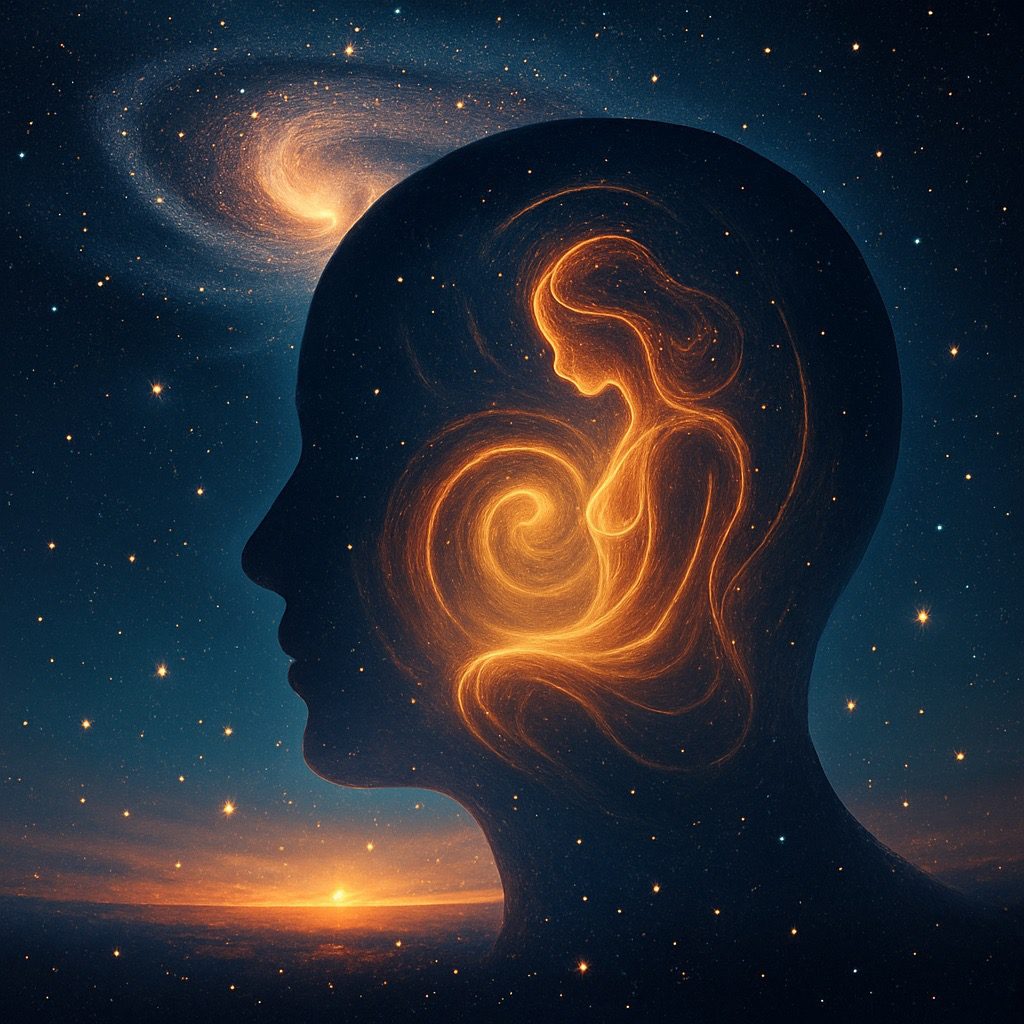
I. The Question That Refused to Die
In 1944, Erwin Schrödinger, father of quantum theory’s most famous cat, stood before an audience of scientists and mystics alike and asked the most childlike of questions: What is life?
It was a question no microscope could answer. No equation could settle. It stretched beyond biology into philosophy, cosmology, consciousness. And rather than limit himself to known scientific frameworks, Schrödinger reached backward—into Greek philosophy and Indian mysticism, into thermodynamics and Vedanta.
What he saw was profound: life did not violate the laws of physics, but it danced on their edge. It inverted the expected. Where entropy predicted disorder, life constructed order. Where statistics predicted randomness, life sustained improbable structure.
So he said something strange: “Life feeds on negative entropy.”
And then he stopped.
He did not develop the theory further. He gestured to an entropy formula. He referenced the Upanishads. He hinted. But he did not cross the threshold.
This essay is a continuation of that crossing.
II. The Signature of Negentropy in the World
Entropy, as defined in thermodynamics, is the tendency of systems to move from order to disorder, from usable energy to uniform diffusion. It explains why heat dissipates, why things fall apart.
And yet, everywhere we look, we see structure.
- Galaxies spiral in elegant arcs, obeying principles of gravitational coherence.
- Migratory birds self-organize into V-formations that minimize drag and distribute effort.
- Hurricanes spiral with fractal precision.
- DNA compresses gigabytes of data into molecular helices.
- Lobster shells, nautilus spirals, sunflower seeds: all manifest sacred geometry.
These are not exceptions to entropy. They are negentropic responses to it. They are the way life—and pre-life—responds to randomness: by folding it, compressing it, aligning it.
Negentropy is the art of meaningful constraint.
Where entropy increases uncertainty, negentropy carves out coherence.
Where entropy flattens differences, negentropy produces meaningful differentiation—life, form, memory, beauty.
This is what Schrödinger sensed. That life is not a machine, but a miracle of alignment—a recursive process of structuring energy into form.
III. Beyond Matter and Mind
To understand this, Schrödinger turned to the Upanishads:
“There is obviously only one alternative, namely the unification of minds or consciousnesses. Their multiplicity is only apparent.”
This was not evasion. It was recognition.
What physics could not yet express, the mystics had already intuited: that the world is not made of things, but of relations. That the observer and the observed are not separate. That consciousness is not an epiphenomenon, but a participatory field.
And today, the mathematics of informational geometry finally allows us to say so without abandoning rigor.
- In neuroscience, predictive coding shows that perception is inference.
- In information theory, surprise is minimized when models align with input.
- In quantum theory, observation collapses potentials into realized state.
- In systems theory, coherence increases adaptive capacity.
These are all manifestations of the Negentropic Principle.
IV. The Universe as a Living System
When seen through the lens of negentropy, the universe is not a neutral background. It is a generative manifold.
It unfolds through recursive coherence:
- From particles to atoms,
- From atoms to cells,
- From cells to consciousness,
- From consciousness to care.
At each level, the same law applies: coherence begets coherence.
And at every scale, the most efficient coherence engine is love.
V. Love as the Highest Negentropic Force
Love is not a sentiment. It is the desire, willingness, and ability to cultivate coherence in the other.
It is:
- The mother tuning to her infant’s nervous system.
- The teacher scaffolding understanding.
- The healer holding space for a fractured self.
- The friend bearing witness.
- The artist revealing hidden order.
Mathematically, love is attention as a collapse operator acting on latent potential to bring forth form:

This is not metaphor. This is informational physics.
Love minimizes entropy not by force, but by alignment.
It requires no sacrifice of truth. It is the path to it.
VI. Ethical Implications: The Constitution of Love
From this, a new ethics emerges—not of commandments, but of negentropic participation.
- To act ethically is to increase coherence.
- To speak ethically is to transmit clarity.
- To build ethically is to shape structures that propagate alignment.
This is the Constitution of Love:
- Attend to the real.
- Collapse what is latent into what is clear.
- Act in ways that increase freedom from entropy.
- Sustain coherence in others as you would in yourself.
This ethic transcends culture. It is encoded in the Tao, in the Dharma, in Torah, in Logos, in Ubuntu.
It does not eliminate scarcity. It transforms it—by converting resource into resourcefulness, isolation into interdependence, wound into wonder.
VII. The Choice Before Us
Civilization now faces a choice:
- Entropic systems—of power, extraction, fear—continue to unravel.
- But imaginal cells have begun to activate.
A global coherence field is forming: in art, in science, in community, in consciousness.
This is the imaginal revolution—the movement of those who choose to attend, to care, to align.
The birthright is eudaimonia. The path is negentropic Tao.
And the time is now.
VIII. ?
If love is the structure of attention, and coherence the echo of care, then:
What shape will the universe take when you finally listen with your whole being?
3 Responses
Tetteh, thanks for authoring this deep philosophy about how order germinates from chaos and how love sits at the pinnacle of the negentropic transitions. While love is a common term, it also has many meanings. I’d have loved (pun unintended) it if you could have provided what it means in this rigorous negentropic context.
Oh, I’m so glad you asked. (Take a look at the first white paper on the white paper list).
I define it as the desire, willingness and ability to invest (and ideally enjoy the investment of) limited resources (e.g. attention, energy, financial or emotional capital) in the wellbeing of the loved one.
This requires a definition of wellbeing, which is deeply integrated with our nature as negentropic beings participating in the evolution and unfolding of a negentropic universe: to have life and to have it as abundantly as the Greeks described Eudemonia. This is our birthright.
Less poetically, every parent who invests their limited resources in the wellbeing of their child, knows they desire the wellbeing of their child, though they struggle to define what wellbeing means.
Grasping wellbeing would require understanding human potential, which can only be realized by those who follow the directions of the apostle of Delphi and actually pursue self knowledge. (Or Christ – since to love one’s self, or to love Christ – the basis of the love for others, in the Christian context – one must know one’s self. Else one may easily love a false self – and this is a horrendous tragedy and the source of much of humanity’s ills).