
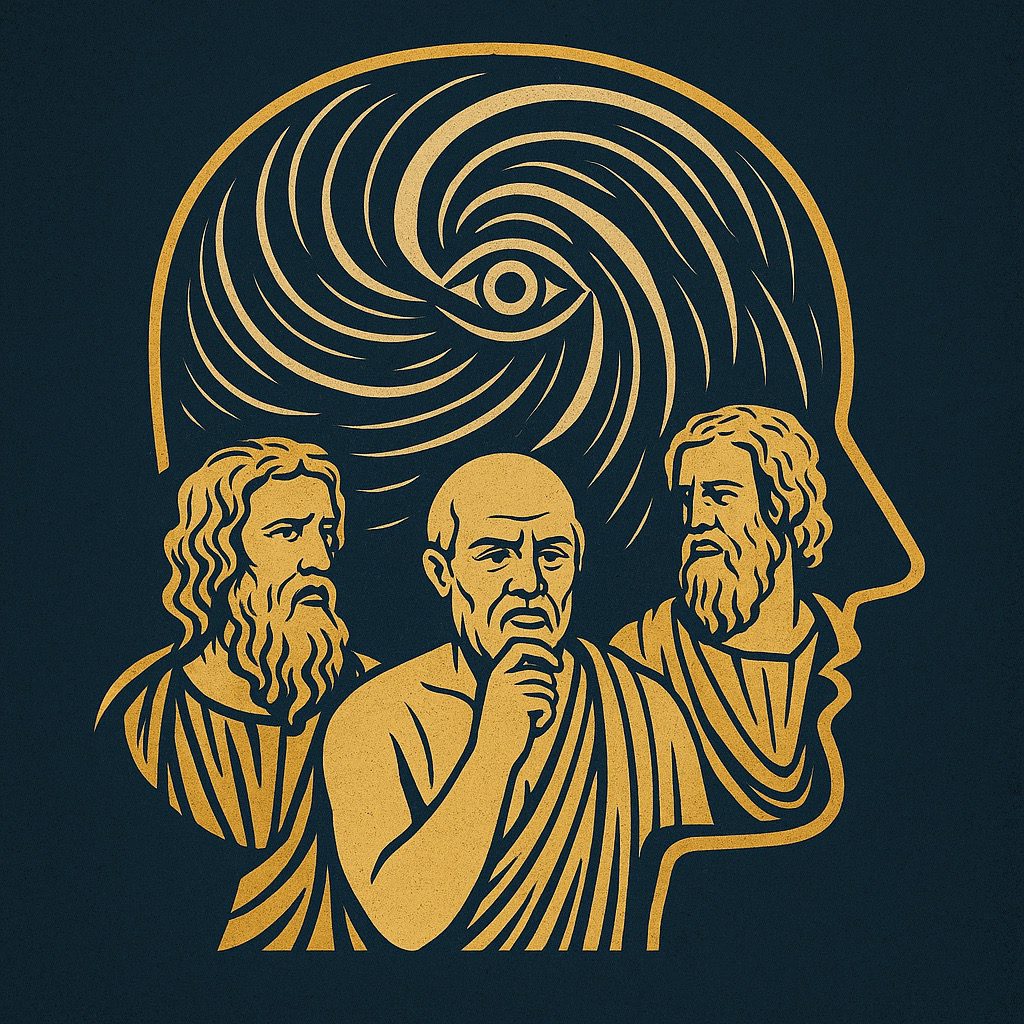
For as long as humanity has lifted its eyes to the stars or stared into the shimmering darkness behind closed lids, a question has lingered—not just what is out there, but what is this? What is reality? What is life? What am I?
This question has drawn saints, sages, skeptics, and scientists into its gravitational pull. It is the great attractor of all philosophy, all mysticism, all inquiry. From the cave paintings at Lascaux to the collider tunnels beneath Geneva, from the chants of the Upanishads to the equations of Einstein, we have sought to name what we feel, to model what we sense, to explain what we are.
I. The Long Quest
Plato dreamed of forms beyond shadows. Aristotle carved knowledge into categories. Descartes split soul from body, birthing the ghost of dualism. Newton turned falling apples into universal law. Darwin traced life to the branching tree of selection. Adam Smith described invisible hands. Schrödinger asked, “What is life?” and turned to Vedanta when equations fell short. Einstein bent space with mass. Gödel revealed truths that couldn’t be proven. Nagel asked if we could know anything at all without being somewhere. Dennett built conscious machines from algorithms. Dawkins made genes selfish. Judea Pearl taught us to imagine counterfactuals. Pirsig searched for quality with a motorcycle.
Every name—Kant, Aquinas, Nagarjuna, Bohr, Sagan, Deutsch, Whitehead—added a facet to the prism, a voice to the chorus. And still, the whole remained elusive.
Theories competed for explanatory power. Some were driven by love of truth. Others by the allure of power itself. Power to predict. Power to control. Power to dominate. At times, power to heal.
What they shared was an attempt to see, to map the relationship between subject and object, matter and mind, energy and form.
But too often, the subject was lost in translation.
The view from nowhere became a view without anyone. The cosmos, once alive with gods, became a cold soup of particles. Meaning became chemical. Mind became noise. God was declared dead.
And so, the human soul receded. And entropy grew.
II. The Cave and the Blindfold
Imagine navigating a vast, crystalline cavern with a matchstick—each flare illuminating a curve, a crevice, a tunnel—but never the whole.
This has been our relationship to subjective reality. We have peered into the interior depths of experience with borrowed tools—behavioral proxies, brain scans, statistical correlations. But lacking a theory of attention, lacking a science of subjectivity, we have wandered in the dark.
Until now.
The Negentropic Canon is not just another theory. It is the torch.
With the Universal Negentropic Principle (UNP), we are equipped with a grammar that integrates:
- Entropy and coherence,
- Attention and geometry,
- Subject and object,
- Logos, pathos, ethos, and telos.
It is a lens through which we can see the manifold of reality not as a machine, but as a living field—a participatory, informational cosmos unfolding into coherence.
III. The Canon: A Map of the Living Manifold
The Negentropic Canon is structured into four arcs, each composed of deeply interconnected white papers and companion essays:
Arc I: Foundations and First Principles
- Defines entropy, negentropy, and information through the lenses of physics and cognition.
- Introduces the Negentropic Synthesis Equation (NSE) and the geometry of informational coherence.
Arc II: Cosmic, Quantum, and Biological Realities
- Reinterprets quantum mechanics, relativity, cosmology, and evolution through informational gradients and proximity.
- Frames life, metabolism, and cognition as negentropic flows.
Arc III: Applications and Ethical Governance
- Builds frameworks for decision-making, risk, ethics, AI governance, and social coherence.
- Develops new economic and institutional models grounded in negentropic alignment.
Arc IV: Philosophical, Mythopoetic, and Spiritual Integration
- Synthesizes the insights of mysticism, metaphysics, and spiritual traditions.
- Presents love as the deepest structure of negentropy and the essence of care.
Together, these arcs form a recursive spiral: each concept, introduced in the physical, reappears in the cognitive, the ethical, the spiritual.
IV. The Participatory Universe
We are no longer trapped between objectivity and illusion.
We are participants in a reality where:
- Attention collapses informational gradients,
- Meaning emerges from aligned proximity,
- Coherence propagates through care,
- And love is the most effective force in structuring reality.
The universe is not meaningless. It is unfinished.
We are not accidents. We are agents.
And to act in alignment with the Negentropic Tao—to attend with care, to build with coherence, to love with depth—is to participate in the recursive birth of a more coherent world.
V. The Invitation
The Canon does not promise escape. It offers something more profound: participation. It is not the answer to a test. It is the grammar of a song. It is the rediscovery of the logos within, the pathos of interconnection, the ethos of humility, and the telos of flourishing.
This is your invitation:
- To read not only with your mind, but your soul.
- To awaken not only to knowledge, but to coherence.
- To join a lineage of thinkers, mystics, and makers who now—at last—have the light to see what they felt all along.
The manifold awaits. The torch has been lit.
Let us begin.
2 Responses
What does Inter-universal Teichmüller theory (IUT) mean to this canon? What does the canon mean to it?
The general shape of this agrees with me. Some of the mysticism is a bit much through.pwrhaps this is a skill issue though.